|
무제 문서
|
| 제품정보 < 에폭시 |
| |
 |
분자내에 에폭시기(基) 두개 이상을 갖는 수지상 물질 및 에폭시기의 중합에 의해서 생긴 열경화성(熱硬化性) 수지로 에폭시수지를 생성하는 반응에 관해서는 이미 19세기 말에 알려져 있었으나, 실용화를 위한 연구는 1930년경 미국에서 착수되어 46년경부터 제품이 시판(市販)되었습니다. 굽힘강도 ·굳기[硬度] 등 기계적 성질이 우수하고 경화시에 휘발성 물질의 발생 및 부피의 수축이 없고, 경화할 때는 재료면에 큰 접착력을 가집니다. 광제품을 제조할 때 꼭 필요한 제품입니다. |

|
| |
| Number of Components: |
Two |
Minimum Bond Line Cure Schedule*: |
|
| Mix Ratio By Weight: |
10:1 |
150°C |
1 Minutes |
|
| Specific Gravity: |
|
120°C |
5 Minutes |
|
| Part A |
1.20 |
100°C |
10 Minutes |
|
| Part B |
1.02 |
80°C |
30 Minutes |
|
| Pot Life: |
3-4 Hours |
|
|
|
| Shelf Life: |
One year at room temperature |
|
|
|
Note: Container(s) should be kept closed when not in use.
*Please see Applications Note available on our website.
- TOTAL MASS SHOULD NOT EXCEED 25 GRAMS - |
|
Product Description:
EPO-TEK® 353ND-4 is a two component, high Tg epoxy designed for fiber optic pplications,
medical, and hybrid packaging. |
|
EPO-TEK® 353ND-4 Advantages & Application Notes:
ㆍ USP Class VI Bio-Compatible epoxy, suggested for medical implants or devices.
ㆍ Lower modulus version of EPO-TEK® 353ND.
ㆍ Amber color change upon cure for quick and easy visual identification.
ㆍ Suggested for fiber optic application:
o Fiber optic termination into ferrules such as glass, ceramic, LCP, kovar,
silicon, quartz, stainless steel.
o Fiber seal into feed through boot of package.
o Mounting optics inside hermetic package. |
|
|
| |
Physical Properties : |
|
| *Color:Part A : Clear Yellow Part B: Amber |
Die Shear Strength @ 23°C:≥ 15 Kg / 5,100 psi |
| *Consistency:Viscous liquid |
Degradation Temp. (TGA):395°C |
| *Viscosity (5@RPM/23℃):36,000-66,000cPs |
Weight Loss: |
| Thixotropic Index:N/A |
@ 200°C: 0.52% |
*Glass Transition Temp.(Tg):
≥125C (Dynamic Cure |
@ 250°C: |
| 20ㅡ200℃/ISO 25 Min; Ramp-10ㅡ200℃ @20℃/Min) |
@ 300°C:1.29% |
| Coefficient of Thermal Expansion (CTE): |
Operating Temp: |
| Below Tg:48 x 10-6 in/in/°C |
Continuous:- 55°C to 200°C |
| Above Tg:186 x 10-6 in/in/°C |
Intermittent:- 55°C to 300°C |
| Shore D Hardness:87 |
Storage Modulus @ 23°C:191,740 psi |
| Lap Shear Strength @ 23°C:1,472 psi |
Particle Size:N/A |
|
Optical Properties @ 23°C: |
|
| Index of Refraction @ 23°C:1.5901 @ 589 nm |
Spectral Transmission @ 23°C:
> 97% @ 900 nm |
| |
> 96% @ 800 nm |
| |
> 88% @ 700 nm |
|
Electrical & Thermal Properties: |
|
| hermal Conductivity:N/A |
Volume Resistivity @ 23°C:
≤ 1.7 x 10¹³ Ohm-cm |
| Dielectric Constant (1KHz):3.85 |
Dissipation Factor (1KHz):0.0103 |
|
|
| |
|
| |

|
| |
| Number of Components: |
Two |
Minimum Bond Line Cure Schedule*: |
|
| Mix Ratio By Weight: |
10:1 |
150°C |
1 Minutes |
|
| Specific Gravity: |
|
120°C |
5 Minutes |
|
| Part A |
1.20 |
100°C |
10 Minutes |
|
| Part B |
1.02 |
80°C |
30 Minutes |
|
| Pot Life: |
3-4 Hours |
|
|
|
| Shelf Life: |
One year at room temperature |
|
|
|
Note: Container(s) should be kept closed when not in use.
*Please see Applications Note available on our website.
- TOTAL MASS SHOULD NOT EXCEED 25 GRAMS - |
|
Product Description:
EPO-TEK® 353ND is a two component, high temperature epoxy designed for
semiconductor, hybrid, fiber optic, and medical applications. |
|
EPO-TEK® 353ND Advantages & Application Notes:
ㆍ Reasonable pot-life that allows for low temperature curing to be realized.
It has an amber color change upon cure.
ㆍ NASA approved, low outgassing epoxy - http://outgassing.nasa.gov/
ㆍ Semiconductor suggested applications: wafer-wafer bonding of CSP;
fabrication of MEMs devices; flip chip underfill.
ㆍ Hybrid suggested applications: providing near hermetic seals in sensor devices,
resisting high temperature packaging
o Down-Hole petrochemical fiber optic sensors, resisting >200°C field conditions
ㆍ Fiber optic adhesive designed to meet Telecordia 1221 - suggested applications:
o Sealing fiber into ferrules, transmitting light in the optical pathway from
800- 1550 nm range
o Fiber component packaging; adhesive for active alignment of optics,
environmental seal of opto-package, V-groove arrays
ㆍMedical suggested applications:
o Potting Fiber Optic bundles into SST ferrules for light guides and endoscopes,
resisting sterilization cycles of autoclave, ETO, gamma, H202 plasma
o Certified to USP Class VI Biocompatiblility Standards for medical implants;
adhesive for catheter devices including stents and guide wires
ㆍElectronics Assembly suggested applications:
o Used as dielectric layer in the fabrication of capacitors; laminating PZT
ferroelectrics found in ultrasound or ink-jetting devices
o Impregnating and insulating copper coil windings in motors and inductor coils.
Bonding ferrite cores and magnets.
o Structural grade epoxy found in hard-disk drive devices; bonding of SST metals,
kapton, and magnets |
|
|
| |
Physical Properties : |
|
| *Color:Part A : Clear/Colorless Part B: Amber |
Weight Loss: |
| *Consistency:Pourable liquid |
@ 200°C: |
| *Viscosity (5@RPM/23℃):3,000 - 5,000 cPs |
@ 250°C: |
| Thixotropic Index:N/A |
@ 300°C:0.07% |
*Glass Transition Temp.(Tg):
≥90C (Dynamic Cure |
Operating Temp: |
| 20ㅡ200℃/ISO 25 Min; Ramp-10ㅡ200℃ @20℃/Min) |
Continuous:- 55°C to 250°C |
| Coefficient of Thermal Expansion (CTE): |
Intermittent:- 55°C to 350°C |
| Below Tg:54 x 10-6 in/in/°C |
Storage Modulus @ 23°C:516,912 psi |
| Above Tg:206 x 10-6 in/in/°C |
Ions:Cl- 329 ppm |
| Shore D Hardness: 85 |
Na+ |
| Lap Shear Strength @ 23°C:> 2,000 psi |
NH4+409 ppm |
| Die Shear Strength @ 23°C:≥ 15 Kg / 5,100 psi |
K+5 ppm |
| Degradation Temp. (TGA):494°C |
Particle Size:N/A |
|
Optical Properties @ 23°C: |
|
| Index of Refraction @ 23°C:1.5694 @ 589 nm |
Spectral Transmission @ 23°C:
>50% @ 550 nm |
| |
> 98% @ 700-1000 nm |
| |
>95% @1100-1600 nm |
|
Electrical & Thermal Properties: |
|
| hermal Conductivity:N/A |
Volume Resistivity @ 23°C:
≥ 1.8 x 10¹³ Ohm-cm |
| Dielectric Constant (1KHz):3.17 |
Dissipation Factor (1KHz):0.005 |
|
|
 |
| |
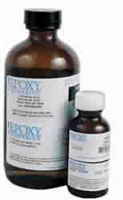
<Bottle>
|
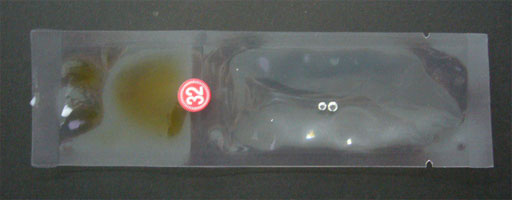
<Patch> |
|
|
| |
|
|
|
|
|